Buying an attached home in Studio City can feel simple at first, until you realize that two properties with similar prices can offer very different monthly costs, rules, and day-to-day living. If you are comparing condos and townhomes here, you are probably balancing budget, location, parking, amenities, and commute convenience all at once. This guide will help you understand how Studio City’s attached-home market works, what current listings suggest, and what to review before you make an offer. Let’s dive in.
Studio City attached homes at a glance
Studio City’s current attached-home market sits in a fairly competitive price range compared with nearby neighborhoods. Current listing snapshots show about 31 condos for sale at a median listing price of $825,000 and 7 townhomes at $710,000, with typical marketing times around 50 to 55 days.
That does not mean every condo costs more than every townhome. It does mean you should expect a broad spread in price depending on size, age, layout, amenities, and building style. In Studio City, the attached-home category includes everything from compact starter units to larger move-up homes with private-feeling entries and multiple levels.
Condo vs townhome in California
In California, the legal form of ownership matters more than the exterior look. A condominium usually means you own the interior unit plus an interest in the common areas, while some homes that look like townhouses may still be part of a planned development with an association.
That distinction matters because association rules, maintenance responsibilities, and shared expenses can affect both your budget and your experience as an owner. In common interest developments, HOAs typically enforce CC&Rs and bylaws under California’s Davis-Stirling framework.
Why the label can be misleading
A home with a private entrance and multiple stories may still function like a condo from a legal and financial standpoint. On the other hand, a property marketed as a townhome may still come with shared obligations and association oversight.
For you as a buyer, the key question is not just, “What does it look like?” It is also, “What do I own, what is shared, and what am I required to pay for each month?”
What Studio City listings look like now
Current listings suggest that Studio City offers a wide range of layouts, but the market tends to cluster around one- to three-bedroom homes. Starter units are often one-bedroom, one-bath homes around 640 to 764 square feet, while larger one-bedroom layouts can reach roughly 944 to 1,094 square feet.
The core of the market is made up of two-bedroom homes. Many current options fall around 950 to 1,539 square feet, often with two bathrooms or two-and-a-half bathrooms. If you need more space, three-bedroom homes commonly run about 1,520 to 1,985 square feet, and some newer construction examples go even larger.
Amenities vary more than you may expect
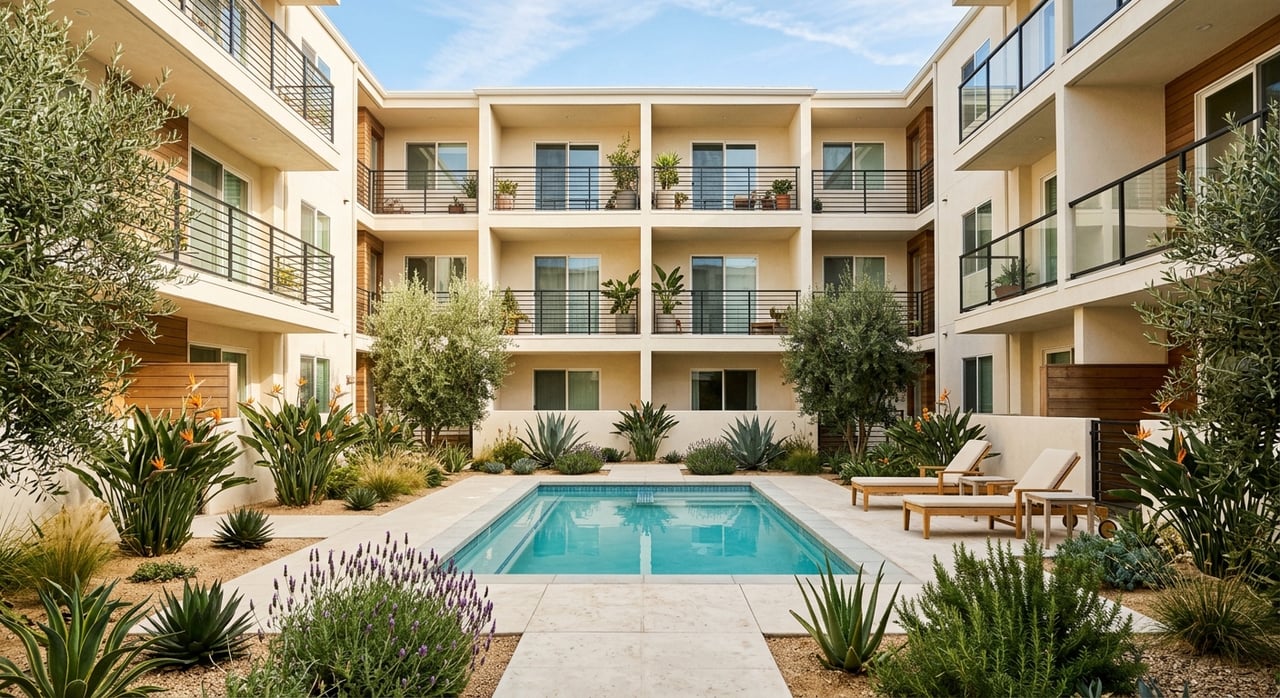
Studio City condos and townhomes can feel very different from one building to the next. Current listings commonly mention pools, spas, guest parking, controlled access, elevators, balconies or patios, in-unit laundry, and attached or tandem parking.
Some homes also advertise rooftop decks or private entries. Others note two or more common walls, while some describe detached or no common walls. That means the same broad category of “attached home” can deliver very different levels of privacy, convenience, and upkeep.
HOA dues can change your budget fast
One of the biggest mistakes buyers make is focusing too heavily on the purchase price and not enough on total monthly cost. HOA dues are usually paid separately from your mortgage, and they can range from a few hundred dollars a month to more than $1,000.
In current Studio City examples, HOA dues vary quite a bit. Recent listings show fees around $300 on a new-construction townhome, $495 on a 1970s condo, $504 and $595 on 2002 condos, $550 on a 1974 townhome, and $705 on an active condo listing near Ventura and Radford.
What HOA dues may cover
Association dues do not all buy the same things. In local listing examples, HOA coverage may include items such as insurance, sewer, trash, pest control, pet allowance, grounds maintenance, water, and even earthquake insurance.
That is why a higher HOA fee is not automatically bad, and a lower one is not automatically better. You need to understand what is included, what is excluded, and whether the building appears financially prepared for future repairs.
Why older buildings deserve extra review
Older Studio City buildings can offer strong locations and roomy floor plans. They can also come with more common walls, simpler amenity packages, and potentially more infrastructure risk behind the walls.
California guidance notes that reserve studies are important because they estimate the cost of repairing or replacing major components like roofs and pavement. It also warns that older conversions may hide future costs in mechanical, electrical, and plumbing systems.
Documents worth reviewing carefully
Before you buy, focus on the documents that help explain both the building’s rules and its finances. The most important items to review include:
- CC&Rs
- Bylaws
- Current HOA budget
- Reserve study
- Insurance summary
- Assessment history, if available
Regular assessments generally fund day-to-day operations and reserves. Special assessments may be used for major repairs or other unexpected common-area costs, so it is smart to ask whether the building has had any and whether more may be coming.
Studio City vs nearby neighborhoods
If you like Studio City but want context for value, nearby neighborhoods can help frame your options. Current condo listing medians show Studio City at $825,000, compared with Sherman Oaks at $674,000, Valley Village at $575,000, North Hollywood at $470,000, and Greater Toluca Lake at $687,000.
That places Studio City above Valley Village and North Hollywood on current condo list prices, and closer to Sherman Oaks and Greater Toluca Lake. Studio City also has fewer active condo listings than Sherman Oaks, so your selection may be a bit tighter.
When to compare other areas
If your budget is the main driver, Valley Village and North Hollywood may be useful comparison points. If you want a similar attached-home lifestyle but want to test pricing and inventory, Sherman Oaks and Greater Toluca Lake may be worth a side-by-side look.
Walkability can shift block by block, so it helps to compare specific locations instead of relying only on a neighborhood name. Current walkability ratings show Studio City at 65, Sherman Oaks at 62, Valley Village at 77, and Greater Toluca Lake at 72.
Commute and transit in Studio City
For many buyers, Studio City works because it offers access to Ventura Boulevard plus a practical transit option. Metro says the Universal City/Studio City station on the B Line connects with bus lines 150, 155, 224, 240, and Rapid 750.
If your routine includes commuting across Los Angeles, that combination can make Studio City easier to live in than a map alone might suggest. It is still important to test your likely route at the times you would actually travel.
A smart Studio City buying framework
When you are comparing condos and townhomes here, it helps to use a simple framework. That keeps you from getting distracted by staging or a trendy feature while missing the details that affect your ownership costs.
Start with these steps:
- Set your true monthly budget, including HOA dues.
- Review the HOA budget, reserves, and assessment history.
- Decide which features matter most, such as parking, guest parking, elevators, or private outdoor space.
- Compare Studio City with nearby neighborhoods if price or inventory becomes a concern.
- Look past the label and confirm the actual ownership structure and association obligations.
Features worth prioritizing
The right home depends on how you live day to day. If you work from home, square footage and layout may matter more than a pool. If you host often, guest parking and a larger living area may be more valuable than a lower HOA fee.
For some buyers, an elevator building is essential. For others, a private-entry townhome feel, attached garage, or outdoor space may be the real deciding factor.
How to shop with confidence
The best Studio City condo or townhome is not always the one with the flashiest finishes. It is the one that fits your budget, supports your routine, and comes with association documents that make sense.
A careful buying process helps you avoid surprises later. When you understand size ranges, HOA costs, building age, amenities, and nearby alternatives, you can make a more grounded decision and negotiate from a stronger position.
If you want a tailored plan for buying an attached home in Studio City, Isabelle Clark offers thoughtful, no-pressure guidance to help you compare options, understand the fine print, and move with confidence.
FAQs
What is the difference between a Studio City condo and a Studio City townhome?
- In California, the legal ownership structure matters more than the exterior style. A condo usually means you own the unit plus a common-area interest, while some townhome-style homes may still be association-governed planned developments.
How much are HOA dues for Studio City condos and townhomes?
- Current Studio City listing examples show HOA dues ranging from about $300 to $705 per month, depending on the property, age, and what the dues cover.
What do Studio City HOA fees usually include?
- Local listing examples show HOA dues may include items such as water, trash, sewer, insurance, earthquake insurance, pest control, and grounds maintenance, but coverage varies by property.
Are Studio City condos more expensive than nearby neighborhoods?
- Current condo listing medians place Studio City above Valley Village and North Hollywood, and near Sherman Oaks and Greater Toluca Lake, so it often sits in the upper part of the nearby attached-home price range.
What documents should you review before buying a Studio City condo?
- Key documents include the CC&Rs, bylaws, current HOA budget, reserve study, and insurance summary, along with any available assessment history.
Are older Studio City condo buildings risky to buy?
- Not necessarily, but older buildings may require closer review because reserve needs and hidden system costs can be more significant, especially in mechanical, electrical, and plumbing components.
