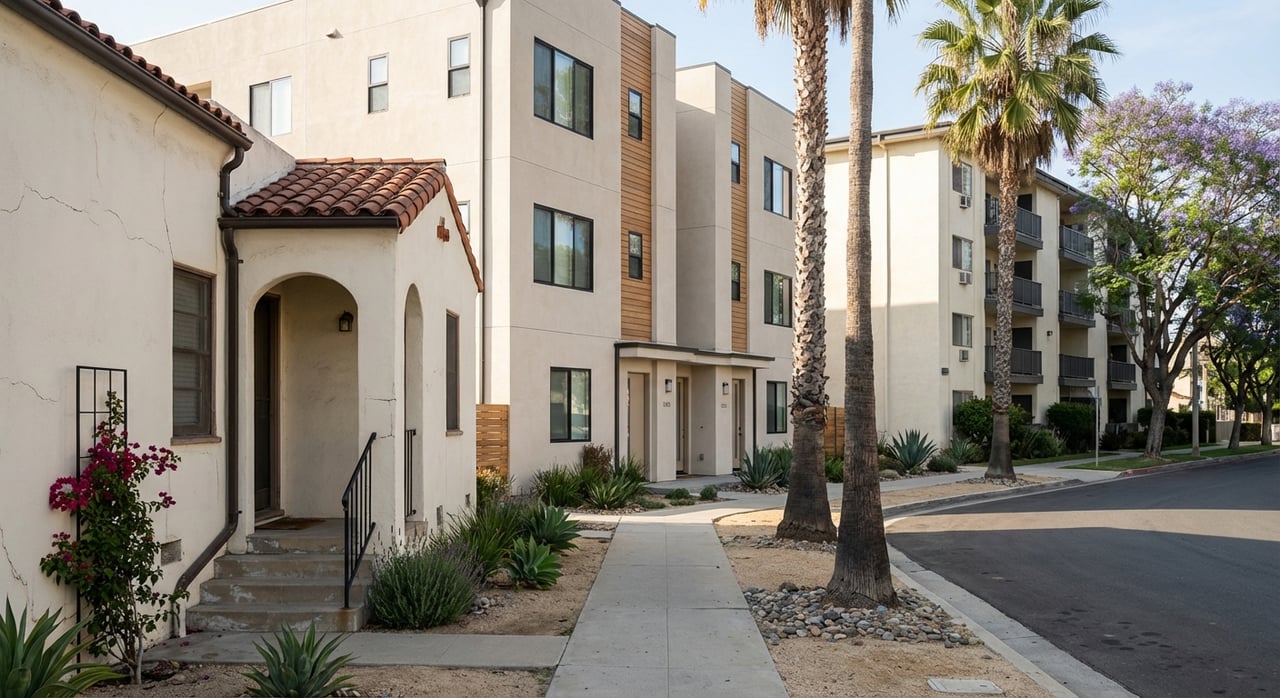
Trying to choose between a condo, a townhome, or a house in Burbank? With prices, rules, and locations that feel worlds apart, it can be hard to know where to start. You want a home that fits your budget, supports your lifestyle, and holds up as a smart investment. In this guide, you’ll compare real monthly costs, HOA rules, financing and approval hurdles, and the neighborhoods where each option shines so you can decide with confidence. Let’s dive in.
Burbank market snapshot
Burbank is an expensive Los Angeles submarket. Recent market trackers report a citywide median sale price near about $1.45 million, while a smoothed home value index sits around $1.16 million. Different data windows and methods can create 5 to 15 percent swings, so expect variation week to week.
By property type, you’ll often see these broad brackets in active listings and recent sales:
- Condos: many options from the mid 500s into the 700s, with median asking prices commonly in the low 700s depending on building and zip.
- Townhomes: a step up from condos, with city summaries near the $800,000 mark and wide variation by neighborhood.
- Single-family homes: often in the $1.1 million to $1.6 million range, with hillside pockets selling higher.
Rents sit well above national norms, with recent snapshots around $2,690 for median asking rent. That rent pressure can support investor interest and make owning feel more attractive if the numbers work for you.
Condo vs townhome vs house: what changes for you
What you own and maintain
- Condos: You typically own the unit interior plus a shared interest in the building’s common areas. The HOA controls exterior components, the roof, and shared systems, and it carries a master insurance policy. You carry an HO-6 (condo) policy for your interior finishes and personal property. See a clear breakdown of coverage types in this condo vs homeowners insurance guide.
- Townhomes: These can be legally structured as condos or as fee-simple homes in a planned unit development. The difference changes who insures what. Some HOAs have an all-in master policy that covers interior finishes, while others are walls-out and expect owners to insure more. Always read the CC&Rs and the insurance summary, and review lender rules for project eligibility explained here: condo project approval basics.
- Single-family houses: You own the structure and the land, which gives you control and privacy, and you handle all maintenance. You also carry a standard homeowners policy for the dwelling and liability.
HOA dues, rules, and reserve risk
HOA fees vary widely by building size and amenities. Southern California averages commonly fall around $300 to $400 per month for standard condo communities, and many Burbank resales show dues in the low hundreds, with amenity-rich complexes higher. For context, see regional patterns in this overview of average HOA fees in California.
California HOAs operate under the Davis–Stirling Act, which sets rules for governance, disclosures, budgets, and enforcement. When you evaluate an attached home, request the full HOA packet: CC&Rs, bylaws, budget, reserve study, insurance summary, and recent board minutes. Learn the framework here: Davis–Stirling Common Interest Development Act.
Two key risks to check early:
- Master insurance scope and deductible. Confirm whether the master policy is all-in or walls-out and whether the HOA relies on the California FAIR Plan for fire coverage. You will use an HO-6 policy to fill gaps. Review coverage concepts in this condo insurance explainer.
- Special assessments and reserves. A low reserve balance or big capital projects can mean future assessments that raise your costs.
Financing and qualifying differences
Loan limits matter in Burbank. For 2026, the high-cost conforming ceiling for a one-unit property is $1,249,125 in many high-cost counties, including Los Angeles County. That keeps many condos, townhomes, and some single-family homes within conventional limits, while larger hillside properties can require high-balance or jumbo financing. Check current caps here: Fannie Mae loan limits.
Attached homes can face extra lender scrutiny. Many condo and townhome projects must meet project-level standards such as owner-occupancy, reserves, and litigation status. If a project fails a review or is not on an approved list, FHA, VA, or some conventional loans can be harder or more expensive. See a plain-English overview of condo approval requirements.
Lenders include HOA dues in your debt-to-income ratio, which can reduce your maximum loan size compared to a similar house with no dues. Here’s how lenders view debts and housing costs: what counts in DTI.
Current rate context: national 30-year fixed purchase quotes were around 6.0 to 6.2 percent in early February 2026, varying by credit, down payment, and lock date. See a recent snapshot of mortgage rate trends.
Where each option tends to fit in Burbank
Downtown and the Media District
If you value short walks to cafés, services, and transit, you’ll see more condos and mixed-use buildings downtown and near the studios. The city’s center plans encourage denser, transit-oriented housing in this corridor, reflected by recent and planned mixed-use projects. For a visual of the urban pattern, review this note on Downtown Burbank mixed-use development.
Airport District and near freeways
In the south and west, you’ll find more mid-century homes and some of the city’s relative value for detached houses within Burbank limits. Proximity to the airport and regional rail can be a draw for commuters. Townhomes and smaller single-family homes are realistic targets here for buyers stepping up from condos.
Hillside, Rancho, Magnolia Park, and Toluca Lake
These neighborhoods skew toward single-family homes on larger lots, often at higher price points. If you prioritize outdoor space, privacy, and separation from neighbors, this is where you’ll focus your search. Many homes here offer views and more traditional neighborhood streets.
Lifestyle tradeoffs to weigh
- Privacy and noise: Condos have shared walls, common entries, and elevators, which means less privacy. Townhomes often give you a private entry and sometimes a small yard. Detached houses offer more privacy, with higher upkeep.
- Outdoor space: Condos usually provide a balcony or shared deck. Townhomes often include a small patio or yard. Houses deliver full yards for gardening, pets, and entertaining.
- Maintenance: Condos concentrate exterior upkeep within the HOA. Townhomes vary by CC&Rs, but many exterior items still sit with the HOA. Houses put full maintenance on you, which brings both control and responsibility.
- Commute and studio life: If you work at or near the major Burbank studio campuses, living close to the Media District or downtown can reduce drive time and stress. Shorter commutes also support a more walkable, after-work lifestyle.
- Insurance and disaster exposure: Hillside areas can face elevated fire and earthquake considerations. With attached homes, your cost depends on the master policy’s scope and deductible. Verify what the master covers and what your HO-6 must pick up.
What it might cost each month
Here are simple examples using a conservative 6.1 percent 30-year fixed rate for principal and interest only. Add property taxes, insurance, and HOA for your full monthly total. Property taxes in Los Angeles County often run about 1.1 percent of the purchase price per year divided by 12. You can see how analysts discuss ongoing rate trends here: mortgage rates forecast context.
- Entry condo example: $700,000 purchase with 20 percent down. Loan about $560,000. At 6.1 percent, principal and interest are roughly $3,394 per month. Add HOA dues, commonly $200 to $400 or more depending on amenities, plus taxes and your HO-6 policy.
- Single-family example: $1,300,000 purchase with 20 percent down. Loan about $1,040,000. At 6.1 percent, principal and interest are roughly $6,302 per month. Add taxes and homeowners insurance. No HOA dues in most cases.
Practical tip: Because lenders count HOA dues in your DTI, a condo’s monthly total can end up closer to a lower-priced house than you expect. Always compare the full monthly cost side by side.
Real buyer snapshots
- The studio editor who wants a no-fuss lifestyle near cafés and transit: A downtown condo or a small townhome near the Media District fits. Budget for dues and enjoy low-maintenance living with a quick commute.
- The household with a dog that wants private outdoor space: A townhome with a small yard or a cottage in areas like Magnolia Park can deliver space and privacy without the scale of a hillside property.
- The move-up buyer seeking a yard and room to spread out: A single-family home in the Hillside or Rancho areas offers more outdoor space and separation from neighbors, with a higher purchase price and more maintenance.
Rules that can change your plan
- Short-term rentals: Vacation-style nightly rentals are not allowed in standard residential zones in Burbank. If you were planning to offset your payment with nightly income, that is not a reliable strategy here. Review a summary of Burbank short-term rental rules and confirm with the City and your HOA.
- Condo project approval: Before you fall in love with a condo, ask whether the project is eligible for conventional, FHA, or VA financing and whether there is any active litigation. Learn what lenders look for in project approvals.
- HOA documents and reserves: Request the full package early. Look for reserve strength, planned repairs, master policy details, rental caps, pet rules, and any pending special assessments. California governance basics are outlined in the Davis–Stirling Act.
How to choose with confidence
- Prioritize the must-haves. Decide if your top priorities are privacy and a yard, a walkable location, or a lower-maintenance lifestyle. Let that drive the property type.
- Model the real monthly payment. Use a current rate quote and include taxes, insurance, and HOA dues where applicable. Lenders will count dues in your DTI, so your purchasing power may shift by property type. See what goes into DTI here: what lenders count.
- Check loan fit and limits. If you are buying at or below about $1.25 million with 20 percent down, you may stay within conforming limits. Above that, expect high-balance or jumbo options. Confirm current loan limits.
- For condos and townhomes, start the HOA review early. Get the CC&Rs, budget, reserve study, insurance summary, and board minutes. Clarify the master policy coverage and deductible and confirm project financing eligibility.
- Align with micro-neighborhoods. Downtown and the Media District deliver more attached options and walkability. Airport-adjacent areas offer relative value for detached homes. Hillside, Rancho, Magnolia Park, and Toluca Lake tend to favor larger-lot single-family living.
Ready to compare specific homes and see the numbers side by side? Reach out to Isabelle Clark for a no-pressure consult and a tailored search that fits your budget and lifestyle.
FAQs
What is the legal difference between a condo and a townhome in California?
- Condos usually give you ownership of the interior plus a shared interest in common areas, while townhomes can be condos or fee-simple homes in a PUD, and the distinction affects HOA rules and insurance obligations under the Davis–Stirling Act.
How much are typical HOA dues for Burbank condos and townhomes?
- Many Southern California condo communities fall around $300 to $400 per month, and Burbank resales often show dues in the low hundreds with amenity-rich buildings higher; see regional context here: average HOA fees in California.
Are short-term rentals allowed in Burbank residential properties?
- No, vacation-style nightly rentals are not permitted in standard residential zones in Burbank, and you should confirm both city and HOA rules before assuming any short-term rental income; see a summary of local rules.
Will HOA dues reduce how much I can borrow for a mortgage?
- Yes, lenders include HOA dues in your housing cost and debt-to-income ratio, which can lower your maximum loan size compared with a similar house without dues; here is what lenders count: DTI factors.
What loan limits apply to Burbank buyers in 2026?
- Los Angeles County uses the high-cost conforming ceiling, which is $1,249,125 for a one-unit property in 2026, so many condos, townhomes, and some single-family homes can fit conventional loans; verify current caps here: Fannie Mae loan limits.
Do condos need different insurance than houses?
- Yes, condos rely on an HOA master policy plus an HO-6 policy you carry for interior finishes and personal property, while houses use a standard homeowners policy for the entire dwelling; review coverage basics here: condo vs homeowners insurance.
